

Ego vs. Exo, Active vs. Passive
Ego vs. Exo and Active vs. Passive: Investigating the Effects of Viewpoint and Navigation on Spatial Immersion and Understanding in Immersive Storytelling
How viewpoint and navigation shape immersion, understanding, and audience preferences in VR stories.
Abstract
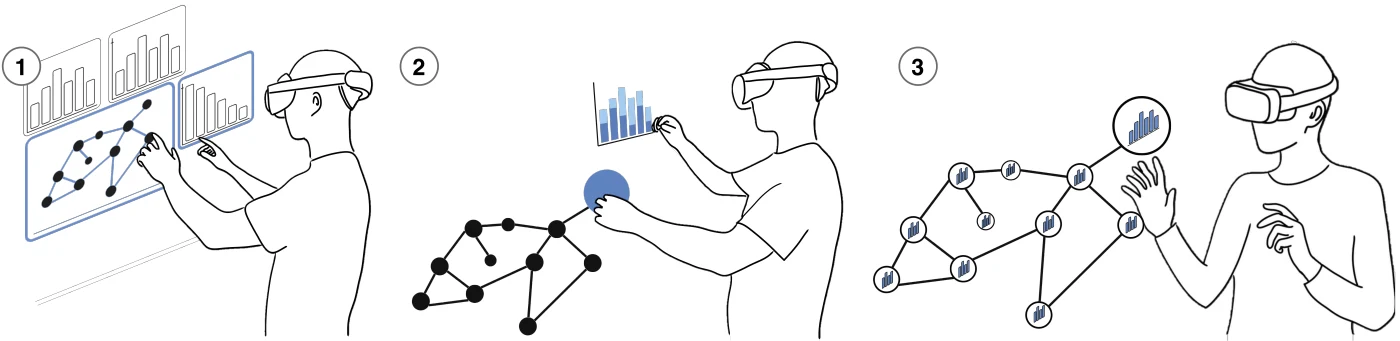
Visual storytelling combines visuals and narratives to communicate important insights. While web-based visual storytelling is well-established, leveraging the next generation of digital technologies for visual storytelling, specifically immersive technologies, remains underexplored. We investigated the impact of the story viewpoint (from the audience’s perspective) and navigation (when progressing through the story) on spatial immersion and understanding. First, we collected web-based 3D stories and elicited design considerations from three VR developers. We then adapted four selected web-based stories to an immersive format. Finally, we conducted a user study (N=24) to examine egocentric and exocentric viewpoints, active and passive navigation, and the combinations they form. Our results indicated significantly higher preferences for egocentric+active (higher agency and engagement) and exocentric+passive (higher focus on content). We also found a marginal significance of viewpoints on story understanding and a strong significance of navigation on spatial immersion.
BibTeX
@article{lu2025egoexoactivepassive,
  title = {Ego vs. Exo and Active vs. Passive: Investigating the Effects of Viewpoint and Navigation on Spatial Immersion and Understanding in Immersive Storytelling},
  author = {Lu, Tao and Zhu, Qian and Ma, Tiffany and Wong, Kam-Kwai and Xie, Anlan and Endert, Alex and Yang, Yalong},
  journal = {Proceedings of the CHI Conference on Human Factors in Computing Systems},
  year = {2025},
}